
One of the most beautiful landscapes in the world, the Napali Coast, will be right at your feet when you reach the end of the Awaawapuhi trail in Kauai (Hawaii).
Kauai is the most historic island in Hawaii accessible to tourists, and despite that, one of the least visited.
It's a volcanic island, but don't expect lava rivers or pyrotechnics. Its volcano fell into an eternal sleep centuries ago.
Now, it's just a matter of time (a very long time) for the weather to erode its profile until it becomes a small atoll of sand and coral covered by the ocean.
Don't worry, you're in luck! You happen to live in an era where Kauai is the most beautiful, remote, and mysterious island in the entire Pacific.
While this might be a matter of taste, dozens of blockbusters like Jurassic Park, King Kong, Indiana Jones, or Jurassic World chose it as their set.
Need more clues?
When you close your eyes and try to remember what the Jurassic Park characters see when they arrive on the island by helicopter or boat, what do you see? Do you remember the green mountain, ridged with razor-sharp rock formations?
Well, it's real. It exists, it's on planet Earth, right within your reach (more or less).
Are you really going to miss it?

Specifically, the footage I'm talking about was filmed on the Napali Coast, the most stunning and inaccessible part of the whole island.
No road will take you there. To get close to its secrets, you'll have to walk, fly, and sail the seas.
And despite your best efforts, you'll never manage to unravel all its mysteries. Or will you? Do you dare to try?
Next up, I'm going to give you some tips and tell you all about our adventure on the Awaawapuhi Trail, one of the best windows into the Napali Coast.
Due to bad weather, it was one of the few trails we hiked during our visit to Kauai in November 2016.
Awaawapuhi Trail

Practical info
- You'll find a parking lot near mile marker 17 on Kokee Road where this trail begins.
- It's 6.2 miles round-trip (about 10 km), descending a total of 1,180 ft (360 m) toward Nualolo Valley.
- You'll need to set aside about 4 hours to complete it.
- It has a medium-high difficulty level.
- A large part of it runs under the shade of the trees.
- The trail is dirt, mostly mud, at least in our case.
- The way out is all downhill, which means the return journey becomes an uphill trek. However, its relative difficulty will depend on the trail conditions. If the ground is muddy from the rain, it's much harder to go down than to climb back up. The risk of slipping and falling is very high in this case, so I recommend wearing good hiking shoes, taking it slow with short steps, and if possible, using a trekking pole or finding a branch to lean on. When the ground is dry, the climb back up is tougher due to the high humidity and heat.
The trail
During the first half of the trail, we had to be super careful not to fall. If you pass the 0.5-mile marker, think of me—that's where I bit the dust! Or the mud, rather. 🙂
We crossed gorgeous giant fern forests and hiked most of the time surrounded by trees. They gave us plenty of cover from the gentle, though constant, rain that had been following us since the parking lot.
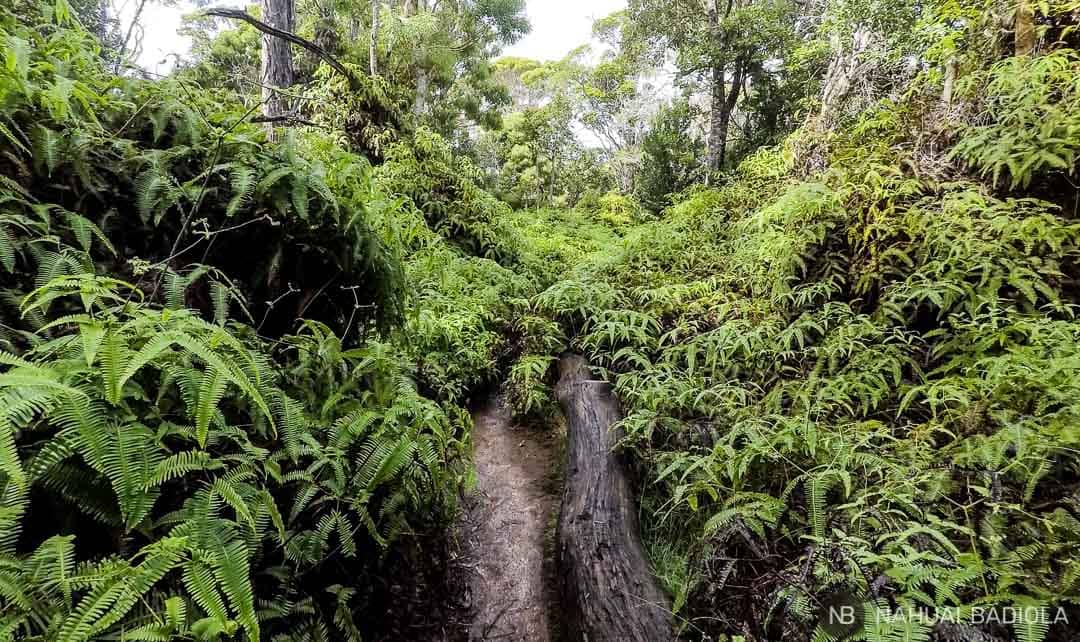
Around halfway through, the ground started to firm up under our feet. The rain stopped and the sun began to break through the clouds, painting rainbows along our path.
You haven't seen a real rainbow until you've seen one in Hawaii.
They're real, massive, almost tangible. When you're standing in front of one, you can't help but thank the rain that accompanied you for bringing it to life. The landscape, already mesmerizing on its own, becomes unimaginably more stunning thanks to them.
Right before reaching the viewpoint, you cross an evocative field of tall grass, as you can see in one of the clips in the video embedded below.
The finish line
And then, that magical moment arrives.
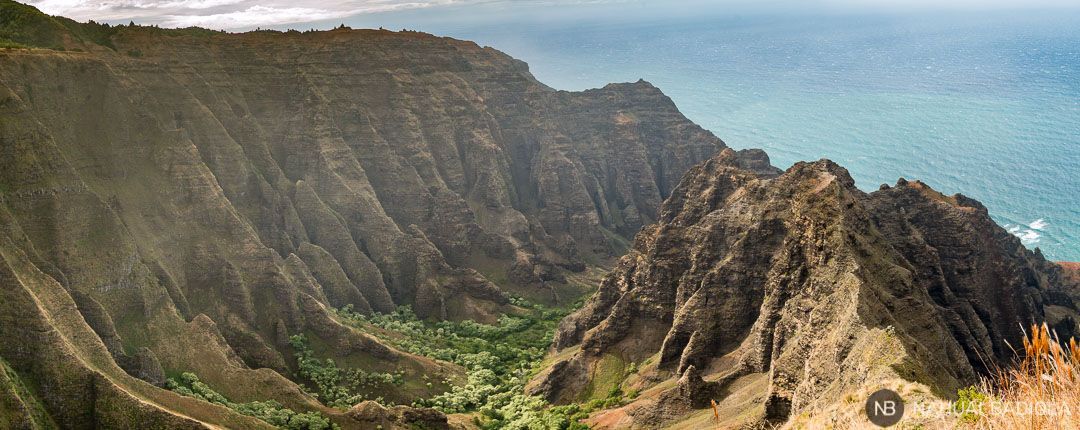
The ground opens up beneath your feet, revealing the signature valleys embraced by mountains eroded over the years into soft, delicate razor-sharp ridges.
The color of the ocean, the clouds, majestic birds soaring between the cliffs… and those impossible rock formations.
And as if that weren't enough, a rainbow adding the perfect finishing touch to the scene.
But… yes, there's a but.
The official viewpoint fence offers limited views of the landscape.
To fully enjoy it, you have to venture into a dusty area with zero protection.
All the signs, both external and internal (if you have an ounce of common sense), urge you not to do it.
We were lucky it wasn't wet. Otherwise, it would have been impossible to walk along it without the risk of falling.
As you move forward, the landscape gets more spectacular at the exact same pace the risk to your life increases. And I'm being completely honest here.

The first few meters in this section aren't that dangerous. The path is still wide and, if it's dry, you can take a few steps without struggling too much. On both sides, the view of the valleys starts to open up, and it's incredible.
My advice: don't go any further.
To keep going, I had to cross from one section to another crouched down on all fours. I did it despite the drop on both sides and pushed through the onset of vertigo, something I'd never experienced before.
Once again here, the landscape became even more spectacular.
Beyond that second stop—which I never went past—lay a narrow, dusty path that wasn't any wider than my hips.
And yes, the views were sensational, though high-risk. Not only was there the fear of vertigo, but also of tripping and falling. The terrain left no room for error.

Despite all this, my photographer made it to the end of the 'unofficial viewpoint' and snapped these sensational photos. Hope you enjoy them!
The way back
On the way back, we noticed the weather hadn't changed at all. Each section of the trail was in the exact same state as in the morning.
The area closest to the ocean remained dry, under clear skies. In contrast, during the last few kilometers and in the parking lot, it was still raining, even a bit harder. Because of this, the mud was even thicker. However, since it was uphill, it was much easier to hike through without slipping.

Deciding Between Awaawapuhi or Nualolo Trail
The Nualolo Trail starts from a parking lot located at the entrance to the Kokee Natural History Museum, between mile markers 15 and 16.
It's just as famous, if not more so, than the Awaawapuhi Trail. A few years ago, there was an intermediate trail called Nualolo Cliff that connected them. This allowed you to start on one and return via the other on the same day, soaking in both landscapes.
Unfortunately, today the Nualolo Cliff Trail is closed because it was destroyed by landslides. Cliff means acantilado, so it's no surprise that this path eventually gave way.
So, to hike both trails, you'll need to set aside two days—if you have them.

I debated for a long time over which one to hike, and in the end, my schedule tipped the scales. Here's a breakdown of the differences between the two, both what I knew beforehand and what I learned firsthand on the trail.
I hope they help you decide if, like me, you don't have enough time to do both.
- Nualolo Trail is slightly longer: 12 kilometers (7.5 miles), compared to 10 kilometers (6.2 miles) for Awaawapuhi.
- The elevation gain/loss on Nualolo is greater: 435 meters compared to 360 meters on Awaawapuhi.
- Word is that Nualolo Trail gets less shade than Awaawapuhi.
- I was also told that the Nualolo Trail is considered tougher—a real leg-burner—because of the constant ups and downs along the way. Awaawapuhi is, essentially, downhill on the way out and uphill on the way back.
- The views are equally gorgeous, looking over the same valley, though the perspective is slightly different. From the viewpoint at Awaawapuhi, you get two valleys for the price of one, both right below your feet with the ocean in the background. From Nualolo, you see a valley from the side, giving you a glimpse of the Napali coast framed behind it over the Pacific. As much as I compared photos of both, I couldn't pick a favorite. It's totally down to personal taste, so you'll have to choose!
- When it comes to danger levels to reach the views at the end of the trail, I'd venture to say that Awaawapuhi is worse. This will vary depending on trail conditions and the risks you're willing to take. Please, use your head.
Practical Tips

What to bring
Here's a list of essential items you should always pack for your visit to Waimea Canyon & Napali Coast:
- Rain poncho and/or rain jacket. Kauai is home to the second wettest spot on Earth, Mount Waialeale. So, it'd be pretty unusual to visit without getting caught in a downpour. A waterproof jacket will come in handy to block the wind, keep you warm, and protect you from light rain. However, when the heavy downpours hit (they're passing showers, don't panic!), a poncho will be a lifesaver since it will cover not just you, but also your backpack and precious camera gear. We put both to good use.
- Proper hiking footwear. I saw a lot of people hiking in flip-flops, and trust me, they did not look like they were having a good time. I recommend hiking boots with Gore-Tex or similar technology to keep the water out. This will be super helpful when you have to scrape off all the caked-on mud without getting the inside wet… speaking from experience! I also noticed some tourists wearing trail shoes with good traction that were somewhat open, like these. They're much easier to wash, lightweight, and perfect for warm climates like Hawaii. If I were going back right now (I wish!), I'd grab a pair of those without hesitation.
- Lightweight clothing. If possible, wear quick-drying clothes. In my opinion, shorts are more comfortable because they won't get nearly as muddy as long pants.
- Food and drinks. If you're heading out on a hike, pack plenty of water (1–1.5 liters per person minimum) and snacks. You won't find drinking water in the restrooms. Also, the only nearby spots to buy food and drinks are a small stand at the Waimea Canyon Lookout and the restaurant next to the museum, where prices are steep and options are limited. It's much better to bring everything with you. Honey granola bars and nuts make great, easy-to-carry energy boosts. Toss in a couple of sandwiches and some fruit, and you'll be set for adventure.
What Not to Bring
In Hawaii, as in almost anywhere in the world, car break-ins are common. Kokee Road is a classic example. Here are the steps to keep in mind so you don't lose your belongings:
- Never leave your luggage or valuables inside a parked car. Take everything with you.
- Don't leave a single item in plain sight, no matter how insignificant it seems. You'd just be tempting fate.
- Don't park in lots where you see broken glass on the ground. That's the universe giving you a clear sign.
- If, for some strange reason, you need to leave something valuable in the trunk (which I strongly advise against), don't open it in the parking lot. Stash everything securely before leaving your accommodation and don't open it again. While on the road, act as if you're carrying nothing at all. This might work if you're only stopping at viewpoints for a few minutes. However, it's high risk if you're leaving the car parked while heading out on a long hike.
For us, following the first three tips listed above kept our car safe from break-ins. But then again, it's always a matter of luck.

Useful links
- Booking deals in Kauai.
- ESTA application.
- International flight deals to Hawaii: Trabber, eDreams and Momondo.
- 5% discount on your IATI travel insurance.
If you want to know more about Kauai, here's all the info I put together from our visit to the island:
- 9-day Kauai road trip, step by step.
- Practical guide to organizing your own trip to Kauai.
- Discover the Napali Coast on a luxury boat.
- Kalalau Trail, Kauai's most demanding trek.
- Kauai's most beautiful beaches: what are you in the mood for today?
- Fly over Kauai in a helicopter… with no doors!
- Waimea Canyon, the Grand Canyon of the Pacific.
- Queen’s Bath, forbidden beauty in the Garden of Eden.
- Mahaulepu Trail, hiking, temples, and pristine beaches in Kauai.
Want to explore another Hawaiian island? Check out our experience in Maui:
- 7-day Maui road trip.
- Guide to planning a DIY trip to Maui.
- The best snorkeling beaches in South Maui.
- Humpback whale watching off the coast of Maui.
- A nightmare before dawn at Haleakala.
- The full description of our experience at O’hoe Gulch and Pipiway Trail.
- 3 days and 2 nights exploring the Road to Hana.
And remember, if you need more info or tips about Hawaii, feel free to drop a comment below! I'd love to help you out however I can.
Hi Celi,
I'm planning a little trip to Hawaii in June and first of all I wanted to say that your website is being super helpful 🙂 but I wanted to ask you a question… For trails like Kalalau, Awaawapuhi, Nualolo… do you need to apply for any kind of permit? If so, how do I do it?
Thanks a lot,
Cheers!
Hi Ihintza,
Thanks so much for the kind words! I'm thrilled to hear my blog is helping you out.
To hike Awaawapuhi and Nualolo, you don't need any permits at all.
As for the Kalalau Trail, if you only want to do the first part up to the Hanakapiai Valley, you don't need a permit. However, if you want to hike the entire trail, you definitely need a camping permit. Here's the link so you can read more details: https://www.losmundosdeceli.com/kalalau-trail/
I hope you have an amazing time on the island and a fantastic trip! Best wishes. 🙂
I'm also planning a trip to Hawaii. Heads up, some trails are closed because of the torrential rain in 2018.
https://kalalautrail.com/
Thanks for the heads-up, Ana! Hopefully they've managed to reopen it by the time you both go. Either way, you can always enjoy this coast from the water. Here's my experience:
Big hug, and enjoy the trip!
Hi there, you say that to hike the Awaawapuhi Trail you have to book at least 4 hours in advance?? How does that work? Where do you book?
Thanks and cheers
Hi Jokin. Thanks for your comment! Sorry if I didn't explain myself well. You don't need to make any kind of reservation anywhere. What I meant by 4 hours is that you should estimate that as the minimum time it'll take to complete the hike, so you don't get caught in the dark or run out of food/water. That's all!
Big hug and enjoy the hike!