
Plan your klotok trip through the Borneo jungle in Indonesia and experience an unforgettable encounter with orangutans in the wild at Tanjung Puting National Park.
Below, you'll discover how to plan your klotok trip, how many days are worth booking to truly enjoy the park, and what it really means to spend several nights under the stars on a riverboat deep in the Indonesian jungle.
Ready for an adventure? 😉
Tanjung Puting: orangutan nature reserve in Borneo
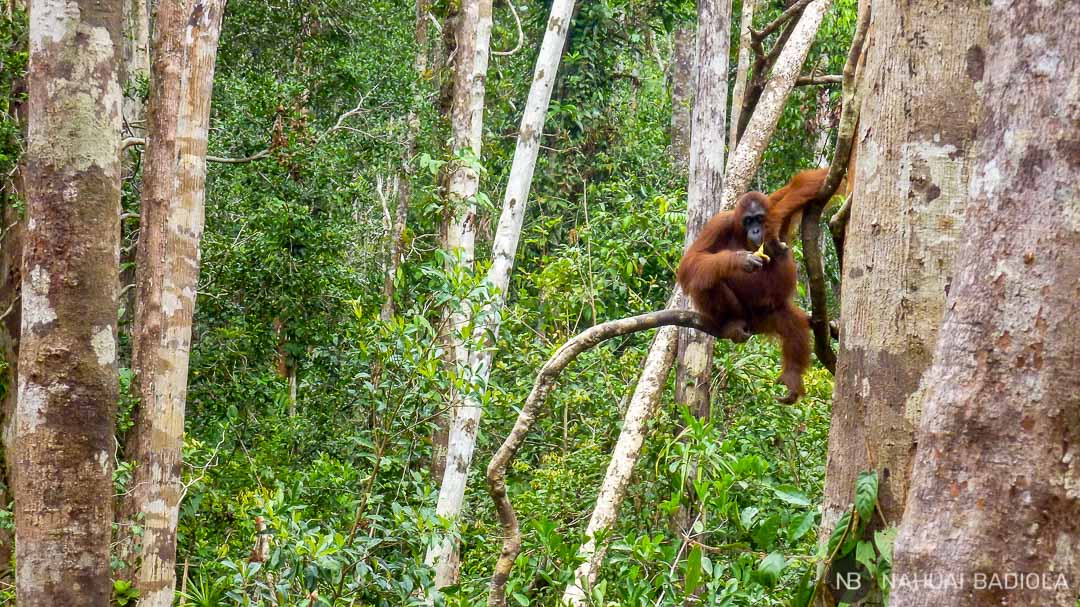
Although all the orangutans you'll see in this national park are free to come and go as they please, in reality, they live in a semi-wild state.
Why? It all has to do with how the park was created.

Due to deforestation and indiscriminate hunting, Borneo's orangutan population and their natural habitat have been endangered for a long time.
In 1971, Dr. Galdikas started an orangutan conservation and research program in Tanjung Puting. She managed to convince people who were keeping baby orangutans in captivity as pets to hand them over so they could be rehabilitated and released.
Her project was a success, leading to the protection of not only the orangutans but all the wildlife and flora within the nature park. From 1971 to today, more than 450 orangutans have been released at Camp Leakey.
However, these animals are very territorial, so despite living freely, they stay close to the area where they were raised. Plus, they're used to getting food once a day at each camp to ensure their survival.
Specifically, feeding times are:
- Camp Leakey – 14:00.
- Pondok Tanggui – 9:00.
- Tanjung Harapan – 15:00.
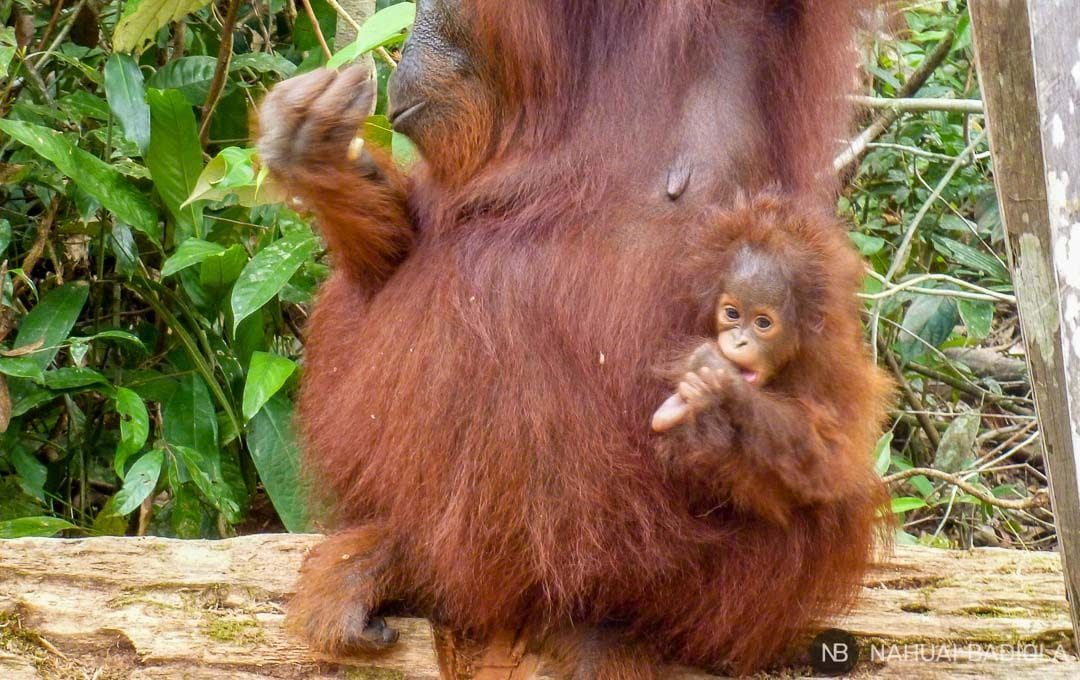
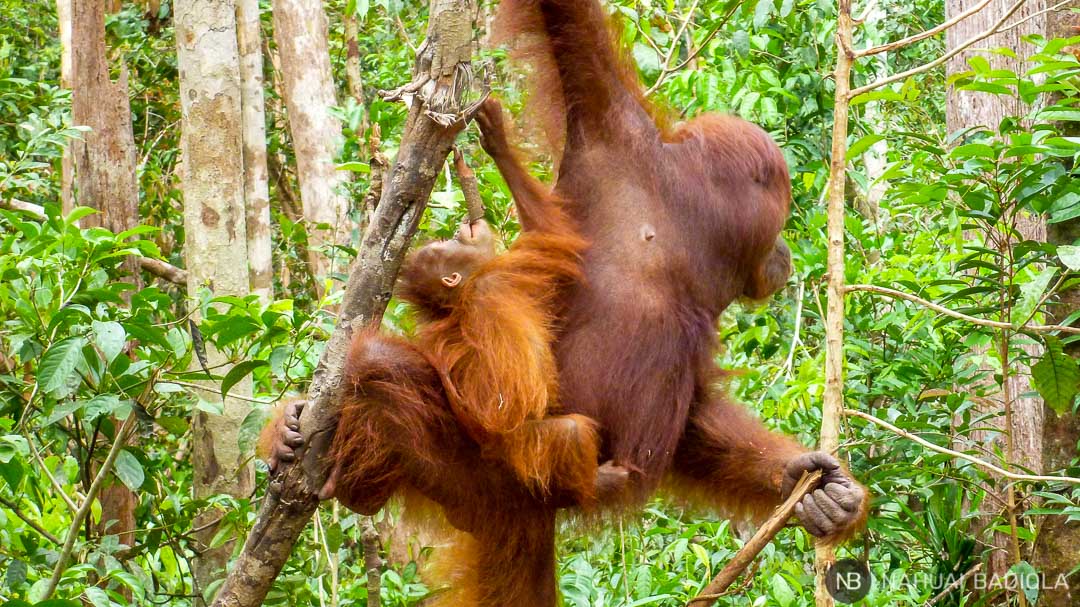
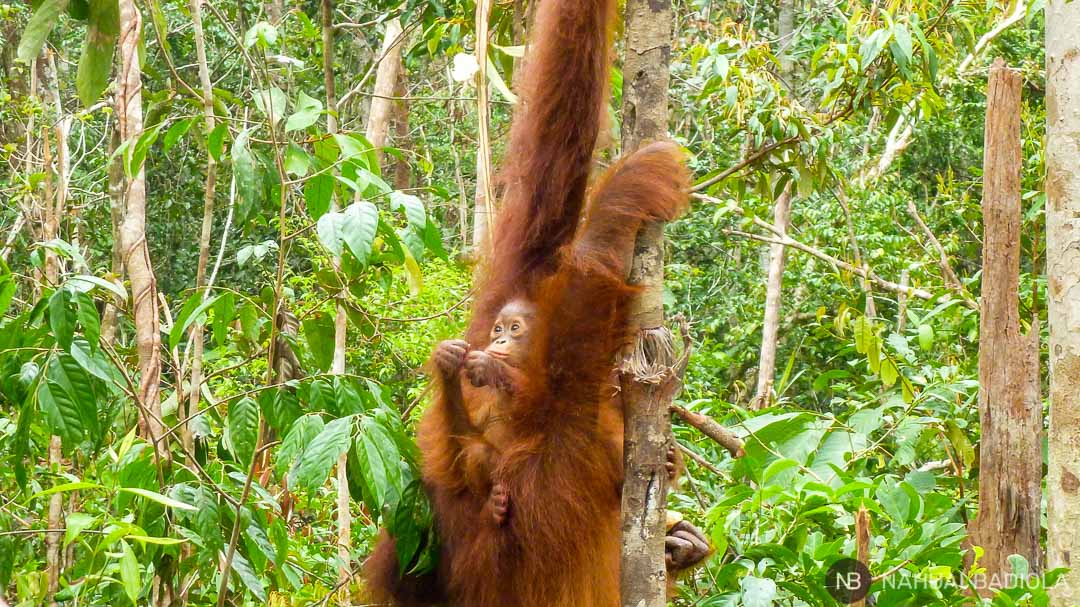
So, it's very common for mothers with babies, who need more energy, to be the ones visiting the feeding platforms most often (much to the delight of tourists, because the babies are super cute, literally). 😉
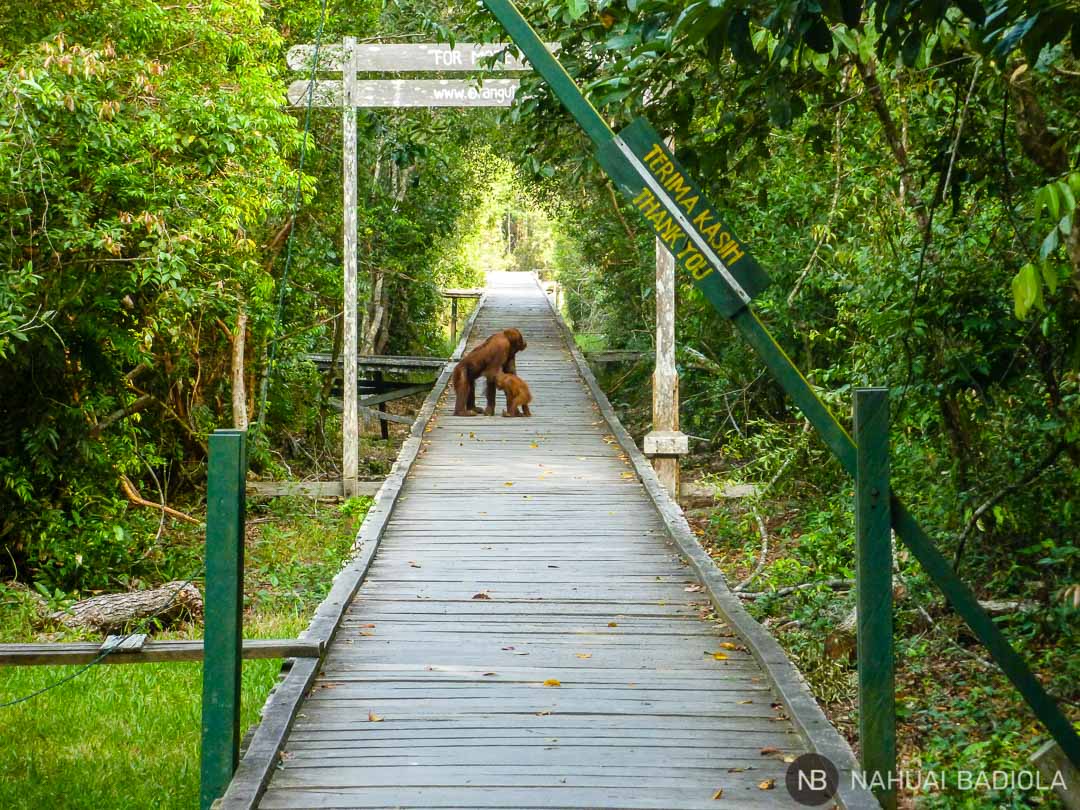
That's why, even though they are free, they will always stay in the park and return to eat whenever they need to. That's why it's considered a semi-wild state.
Their fate is linked to human efforts to ensure their survival and protect their habitat.
How to plan your trip
How many days to book
We were crazy excited to experience our encounter with the orangutans, so we booked a 4-day/3-night tour on a klotok through Tanjung Puting. And I was so glad I made that decision.
Nowadays, I might even book a little more, 5 days/4 nights.
The minimum? Although I know some people only spend 1 night, I recommend spending at least 3 days and 2 nights in the park. Keep in mind that the last day (without an overnight stay) is for heading back.
Buying domestic flights in Indonesia
Ideally, you should arrive at Pangkalan Bun airport as early as possible so you can start your klotok itinerary that very same day.
Back then, it was a bit tricky to buy domestic flights in Indonesia, but we were able to do it without any problems through a website (I'll leave the link at the end of the article).
In our case, we chose to do a round trip from Jakarta the day after our international flight landed.
To make things easier, we stayed overnight during our layover at the FM7 Hotel, which includes a shuttle service to Jakarta airport in the price.
2 heads-up about this hotel:
– Pick a smoking room even if you don't smoke. The room doesn't smell like smoke at all, and the hallways in this area are very quiet. In the non-smoking room sections, people go out into the hallway to smoke at night, making a lot of noise and disturbing those trying to sleep.
– Even though it's very close to the airport, the shuttle bus has to take a big detour to get there, which will also take quite a while during rush hour.
Booking a klotok trip
The most authentic way to visit Tanjung Puting Nature Reserve and see orangutans in the wild in southern Borneo is to book an organized tour on a klotok, a traditional Indonesian riverboat.

The most common approach is to get in touch with them before arriving at your destination. However, it's also possible to hire them once you get to Borneo.
In my case, after some online searching, I reached out to several agencies and klotok owners who had received great reviews on travel forums.
The agencies didn't convince me at all. Besides being more expensive, many of them completely ignored my explicit wish to sleep all 3 nights of the trip on the boat, offering stays at 'ecolodges' instead.
There are several of these eco-hotels in the area, and I'm sure they're great for anyone looking for more comfort. But I wanted adventure…
And out of all the offers I received, I went with the most affordable one, from Noval.
His offer of 6 million rupiah for 2 people for 3 nights and 4 days included:
- Round-trip transportation to the airport in Pangkalan Bun.
- Private klotok for 2 people (we didn't share with other tourists).
- English-speaking guide.
- All meals included (after tasting them, I must say they were delicious).
- Park entrance fee.
- Fees for using photography cameras (we had read that you had to pay extra for them).
- Payment in person, no need to wire anything in advance.
Noval even offered to buy the flights from Jakarta to Pangkalan Bun for us, but the local price was higher than what I was able to find online.
Budget
The conversions correspond to the currency value at the end of September 2012 (nowadays it would be quite a bit cheaper).
- Klotok trip (all-inclusive): 6,000,000 rupiah, around €480.
- Round-trip flights to Jakarta: 2,277,200, €192.5.
- Total airport fees: 102,000 rupiah, €8.5.
- 1-night layover in Jakarta: 650,000 rupiah, around €54.
In total, we spent €735 over 5 days, €73.5 per person per day.
3-day, 4-night klotok itinerary through Tanjung Puting
What daily life on a klotok is like
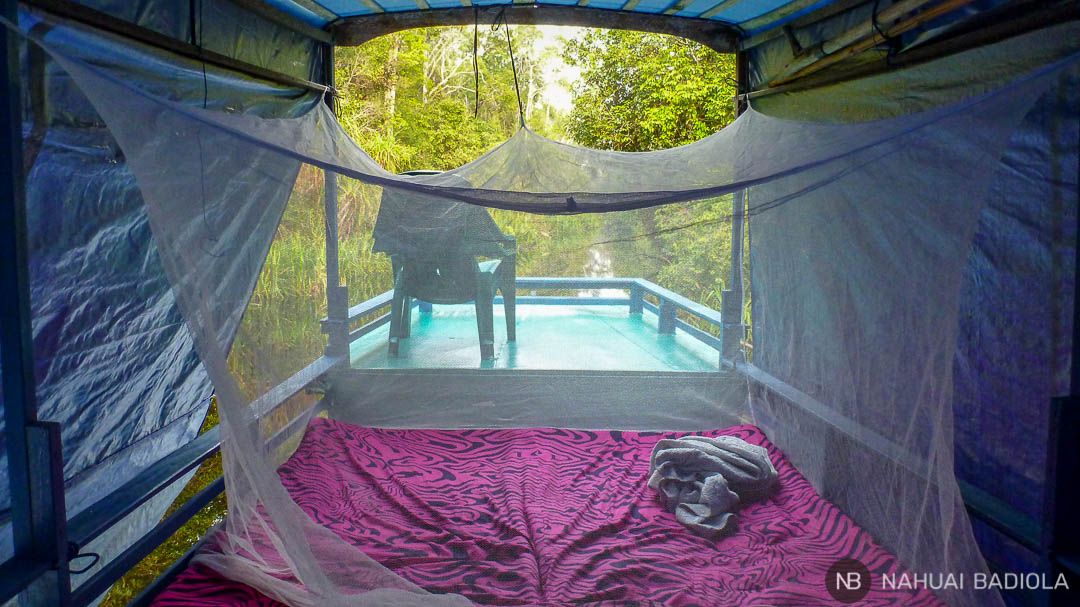
I'll summarize the features of the klotok we traveled on. However, keep in mind that some details might vary depending on the boat:
- The boat: it was very similar in size to the rest of the 2-person boats we saw during our stay and was in good condition, although we did see a few larger and more luxurious ones (the minority).
- The bathroom: it was a small room at the back of the vessel with a toilet that flushed straight into the river and a huge tub of black water from the very river we were on (its color came from dissolved minerals, but it was clear, not muddy). Using a small bucket, we used the water from that container to 'flush', wash our hands, and shower.
- The living area: the klotok deck was for our exclusive use, and to keep it clean, we always walked around barefoot. We ate there, enjoyed the views while cruising, and slept on a double mattress protected by a mosquito net (wonderful to listen to the sounds of the jungle as you drift off to sleep and watch the sunrise the next morning).
- The crew: Noval didn't travel with us; instead, we went on a boat with some of his associates. Ponco was the guide, who spoke English, yes, but only understood Nahuai (and sometimes only halfway). Clearly, my southern accent was tricky for him… Also traveling with us were a cook (wonderful), the boat captain, and his mate.
- The food: INCREDIBLE. After this trip, I fell completely in love with Indonesian dishes. And not only was it delicious, but there were always leftovers, no matter how much we begged them to cook less. I never quite figured out whether it was house policy, because they ate it afterward anyway, or simply because they didn't understand our request. Ouch!
And now that you know the practical details of daily life on a klotok, let me tell you about our 3-night, 4-day route through Tanjung Puting.
Day 1: Camp Leakey
We arrived at Pangkalan Bun airport around 11:30 in the morning (our flight had been delayed by an hour).
Noval's wife met us and took us by taxi to Kumai, where she dropped us off at Ponco's turquoise klotok after we paid. And so we began our journey upriver toward our destination, the furthest camp in the park, Camp Leakey.
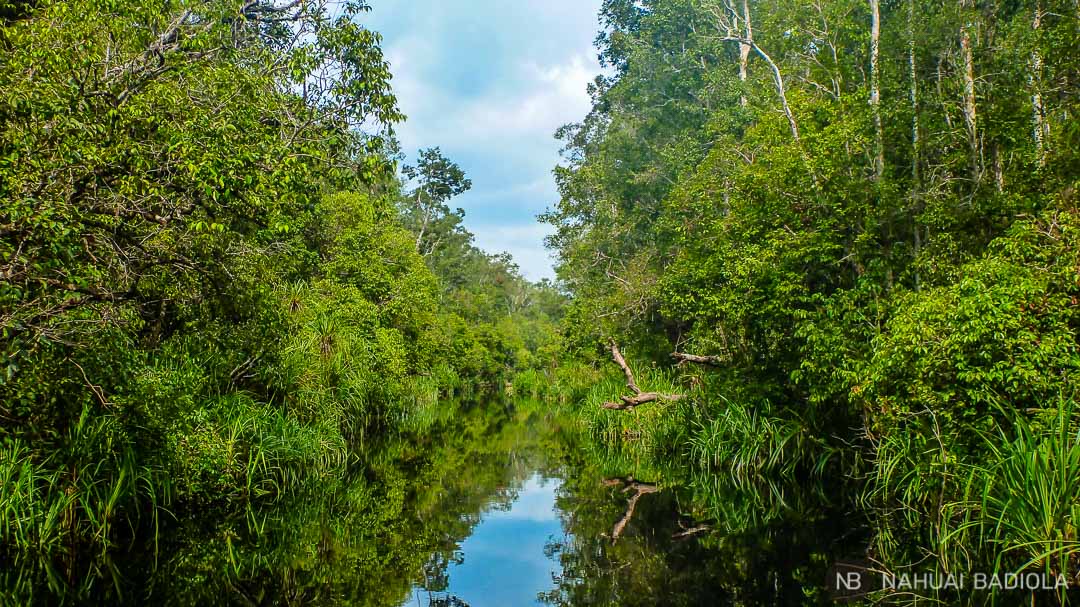
They served us a delicious lunch, and we really enjoyed the ride through the lush greenery, spotting proboscis monkeys, crocodiles, colorful birds, and our first orangutan fishing along the riverbank!
At a certain point, the river water changed from muddy brown to a dark, almost black color, but 100% crystal clear. This would be the water we'd use over the next few days to shower.
Even though we arrived 30 minutes late (the feeding at Camp Leakey takes place at 14:00), it didn't take away from the magic of the moment. There were several mother orangutans with their babies on a wooden platform where park rangers had left kilos of sweet potatoes, cassava, and bananas.

There was so much food that even several wild boar families were roaming around, trying to steal a bite.
It was fantastic. They're so used to tourists that it almost seemed like they were posing for the camera.
After the crowd cleared, we headed back to the dock, where we would spend the night on our klotok. We were lucky that the other boats left for the previous camp (this happens if you only book 2 nights, as far as I know), leaving us with the place all to ourselves. We even witnessed a macaque and orangutan 'party' on the opposite riverbank while having dinner.
And just like that, right in the heart of the jungle under the open sky, protected only by a mosquito net, we spent our first night under the stars in Tanjung Puting.
Nahuai swears he saw rats on the deck in the middle of the night. We liked to think they were field rats (jungle rats, in this case) and not traveling with us. Though that's something we'll never really know…
I felt a bit cold that night, but for the following nights, I solved it by bundling up much more (fleece and thick socks, for example). 😉

Day 2: Camp Leakey
After breakfast surrounded by nature and in complete solitude, we set off on a 3-hour hike through the park. We visited the visitor center where we learned more about the park's work and its volunteers, bumped into more orangutans who loved hanging around the park cabins, and ventured into a gorgeous forest.
After lunch, we headed back to the feeding area, this time well in advance.
And… surprise! A gibbon appears, doing acrobatics through the trees to beg for bananas.

Following our guide's instructions, we offered it small pieces so it could take them directly from our hands. So incredibly soft to the touch! And it seems it liked us, because it stayed with us for quite a while and even let us pet it.
Once the orangutan show was over, we traveled downriver to a dock where we spent the night.
Day 3: Pondok Tanggui and Tanjung Harapan Camps
After breakfast, we set off for the second camp, Pondok Tanggui, located in the murky water area, enjoying the views along the way: proboscis monkeys, squirrels, orangutans… What a treat!
By 9, feeding time at Tanjung Harapan, we were already sitting and waiting for the orangutans to arrive. They made us wait, but oh!
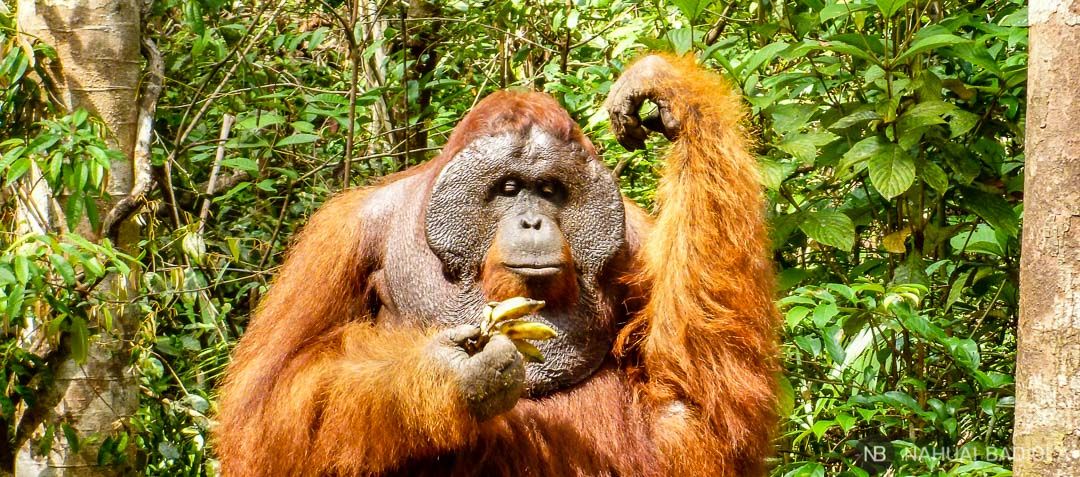
A huge alpha male appeared (you'll recognize him by his round, dish-shaped face and massive size) who even demanded a second serving of milk. Breathtaking!
Next, we continued our route, visited a village near Tanjung Harapan, and caught the 15:00 feeding at this last camp, where only young adults without babies showed up. This was without a doubt the smallest and most picturesque platform, surrounded by vines that invited the orangutans to do acrobatics to get their food.
After the spectacle, we followed the river course until it grew dark and the trees lit up with fireflies (literally, just as I'm telling you). We spent our last night in Tanjung Puting next to one of these natural 'Christmas trees'.
Day 4: Heading back
The trip back to Kumai was very short and honestly a little sad. We would have done it all over again. By 9:30 we were already at the airport, so we had to wait to check in and pay the 22,000 rupiah airport fees (80,000 in Jakarta).
In Jakarta, we spent the night again at the FM7 hotel, because a very different adventure was waiting for us the next day… But I'll leave that for upcoming posts. 😉

Precautions
Luggage on the klotok:
If you have to keep your backpack or luggage on deck, remember to always keep it zipped up. Make sure you don't leave shiny objects or food outside. The macaques are very cheeky.
My recommendation? The lighter you travel, the better. In our case, a backpack under 15 kg each was more than enough. 🙂
Vaccinations and malaria prevention:
To travel to Indonesia you don't need to be vaccinated against yellow fever (mandatory in other countries), unless your region of origin is a risk area.
However, there is a risk of contracting malaria through mosquito bites, so taking preventative medication is recommended. I tried taking Malarone, just like I did during our road trip through Costa Rica, but it made me feel terrible (or so I thought) and I stopped taking it on the second day of the klotok trip.
I have to say that the stomach 'discomfort' stuck with me for the whole trip, so it probably wasn't just that…
Mosquitoes and sun:
Remember to pack sunscreen and mosquito repellent (especially if you're not taking prophylactic medication). You're right in the middle of the jungle, don't forget it. Nahuai has a natural mosquito repellent… me! Ouch! That's why I always go well prepared.

Travel insurance:
Don't risk it. Nowadays, traveling insured with IATI, one of the best insurance companies for travelers, is super cheap.
3 weeks of worry-free and relaxed travel around Indonesia for 110€? Knowing that we won't even have to pay upfront if we have an emergency? Delayed luggage, personal liability, and a ton of money for medical expenses if needed… I don't travel without them anymore.
And if you want to save even more, book through this link to get a 5% discount on the final price.
Useful links
- International flights to Indonesia: Trabber, eDreams, and Momondo.
- Website to buy domestic flights in Indonesia.
- Noval's email (klotok trip): noval.boat (put an at sign) yahoo.com (I'm formatting it like this to prevent bots from spamming his email address).
- Book a klotok on Booking.
- FM7 Resort Hotel next to Jakarta Airport.
- 5% discount when you get your IATI travel insurance here.
Road tripping through Indonesia? Then you'll love these:
- 3-week road trip through Indonesia: Java and Borneo.
- Prambanan, Indonesia's largest Hindu temple.
- Meditate with Buddhist monks at Mendut temple.
- Experience a sunrise from Borobudur temple.
- Selogriyo: a Hindu temple tucked among rice paddies.
- How to organize your visit to Bromo and Ijen: 4 options.
- 3-day, 2-night itinerary through Bromo and Ijen.
- Pulau Derawan: how to get there and spend 7 days on the island.
Tell me, have you been to Tanjung Puting? How was your experience? Were you just as blown away as I was seeing these orangutans up so close?
Hi! Great and very helpful blog! Do you know if Noval is still running the tour, and what his contact email is?
Thanks a lot!
Hi, Vicente. Thanks so much, I'm glad you like the blog.
You have the email address written in the useful links section. You just need to add the at sign between the first and second part; I do it like this so bots don't fill his inbox with spam. If you're not sure what I mean, let me know and I'll send you a private message with the email.
I don't know if he's still running the tour, but the easiest thing is to write to him directly. 🙂
Best regards and safe travels!
Fantastic route. Great photos and helpful tips!
Thanks, Maran. 🙂